
Cette page est en cours de construction. De plus amples détails seront ajoutés dès qu’ils seront disponibles.
Conférence publique commémorative Herzberg :
Lundi 22 juin 2026, 20 h 00-21 h 00, Université Carleton
Connaissez-vous quelqu’un qui sera dans la région d’Ottawa le 22 juin ? Dites-lui de réserver cette date ! Les billets destinés au grand public seront disponibles sur cette page début juin 2026. Les délégués peuvent obtenir un billet lors de leur inscription au congrès.

Neil Turok
Higgs Chair of Theoretical Physics, University of Edinburgh and Roger Penrose Distinguished Visiting Chair, Perimeter Institute for Theoretical Physics
Neil is the inaugural Higgs Chair of Theoretical Physics at Edinburgh. He was born in South Africa to activist parents in the anti-apartheid movement. After studies in Cambridge and London and appointments in California and Chicago, he was Professor of Physics at Princeton, Chair of Mathematical Physics at Cambridge and Director of the Perimeter Institute for Theoretical Physics in Canada.
Neil develops and tests theories of the universe and its basic laws, from the big bang to the far future. Many of his team’s predictions have been confirmed, including correlations between the distribution of galaxies and the cosmic microwave background radiation. He has proposed a new paradigm for cosmology, connecting particles and forces to the dark matter, dark energy and primordial density variations. Its predictions will be tested in the coming decade.
In 2003, Neil founded the African Institute for Mathematical Sciences (AIMS), now Africa’s largest centre for postgraduate training and research in the mathematical sciences. Currently, AIMS operates 6 centres of excellence, in South Africa, Senegal, Ghana, Cameroon and Rwanda. AIMS has over 3,500 Master’s and PhD alumni. In the coming decade, AIMS plans to open 4 additional centres of excellence and to graduate 10,000 students at Master’s level and above.
For his research and for founding AIMS, Neil was awarded a TED Prize. He holds honorary doctorates from nine universities. In 2012, his book The Universe Within: From Quantum to Cosmos won Canada’s top prize for popular science writing. In 2016, he was awarded the John Torrence Tate award of the American Institute of Physics for international leadership in physics. He is an Honorary Fellow of the UK Institute of Physics and a Fellow of the Royal Society of Canada.
A Simpler Cosmology
Observations of the universe on the largest and smallest accessible scales have revealed surprising simplicity. In contrast, the most popular theoretical frameworks predicted a slew of new particles, forces and dimensions on the tiniest, subatomic scales, and a chaotic multiverse on the greatest. The observations should make us reconsider our assumptions. Might there be better explanations for the basic properties of the universe? I’ll outline a new, simpler unified paradigm, based on the known laws of physics and CPT symmetry, which explains (i) the large-scale geometry of the universe and the primordial density perturbations, without inflation, (ii) the dark matter as a right handed neutrino, without any other BSM particle, (iii) why there are three generations of elementary particles, without strings. The new picture provides clues about quantum gravity, the big bang and the arrow of time as well as a potential resolution of the gauge-gravity hierarchy puzzle.
Plenary Speakers:
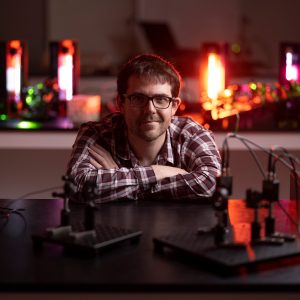
John Donohue | University of Waterloo
Lundi 22 juin, de 9 h à 9 h 45
Dr. John Donohue is an experimental physicist and outreach scientist with the Institute for Quantum Computing (IQC) at the University of Waterloo. His work focuses on teaching and communicating about advances in quantum science and technology, including through hands-on activities and demonstrations and programs like the Quantum School for Young Students (QSYS) and Quantum for Educators (QEd). His research work focuses on experimental quantum information in photonic systems. His work has been recognized by funding from the American Physical Society and Innovation, Science, and Economic Development Canada, and he was invited to speak on quantum education efforts at the opening ceremony of the 2025 International Year of Quantum Science & Technology at UNESCO headquarters. He also served as the Chair of the Division of Physics Education for the Canadian Association of Physicists from 2023-2025.
Quantum for Educators and Young Students
The explosion of public interest in quantum information technologies has provided an opportunity to interest more students in the ideas and applications of quantum mechanics. As research programs and institutes have grown in Canada, so have efforts to reach new communities and teach concepts in new and tactile ways. To allow high-school students to engage with quantum information science on a broad scale, it is essential to provide educators with the resources needed to understand and effectively communicate the topic to students. We have run the Quantum for Educators (QEd) workshop for ten years to address this need, providing hands-on activities and lesson plans designed for the classroom. To ensure broad and equitable access to introductory QIS education, such activities should be low-cost, easy to replicate, and intuitive, as well as connect to material present in the curriculum. In this talk, we will outline the QEd workshop and its approach to topics including quantum communication, quantum algorithms, and uncertainty, sharing survey feedback and lessons-learned from many iterations. We will also explore how enrichment programs can be developed for keen high-school students both in-person and virtually, as in the Quantum School for Young Students (QSYS) summer school which has run for 18 years, and how these connect to undergraduate-level programming like the 16-year-running Undergraduate School on Experimental Quantum Information Processing (USEQIP).
Normand Mousseau | Département de physique, Institut Courtois and Regroupement québécois sur les matériaux de pointe, Université de Montréal and Institut de l’énergie Trottier, Polytechnique Montréal
Mardi 23 juin, de 9 h à 9 h 45
Bio to come
How can physicists contribute to the climate challenge?

Saniya Heeba | Carleton University
Jeudi 25 juin, de 9 h à 9 h 45
I am an IPP Connect Fellow based at Carleton University in Ottawa, Canada. I completed the first two years of my IPP fellowship at McGill University, Canada, where I previously held a Trottier Space Institute Postdoctoral Fellowship. I obtained my Ph.D. in Physics from RWTH Aachen
University in Germany.
My research focuses on analyzing the behaviour of Dark Matter (DM) across different energies and environments and connecting it to detectable experimental signatures. I am particularly interested in
understanding how ambient environments, such as primordial, stellar or interstellar plasmas, fundamentally impact DM observables. I also often create art for my research projects, which is available in the form of little easter eggs on arXiv.
The Universe as a Dark Matter Laboratory
One of the fundamental unanswered questions about the universe is the nature of Dark Matter (DM) — a mysterious, invisible form of matter that accounts for 80% of the universe’s total matter budget. Despite its overwhelming abundance in the Universe, the microphysical properties of DM remain poorly constrained owing to its extremely weak interactions with normal matter. This has resulted in a sprawling DM theory space with several models, potential observable signatures and search
strategies.
In this talk, I will provide a particle physics perspective on approaching the DM question and discuss the many ways it intersects with astrophysics and cosmology. I will demonstrate how to use the universe as a DM laboratory, with an emphasis on using different energy scales
and ambient environments as a test bed for DM physics. Through the course of the talk, I will trace out the possible histories of DM, discuss its impact on astrophysical observables, and make contact with the expansive terrestrial DM experimental program.
Discours pléniers des lauréats de la médaille 2026
De plus amples informations seront publiées une fois que les récipiendaires des médailles 2026 auront été sélectionnés.