
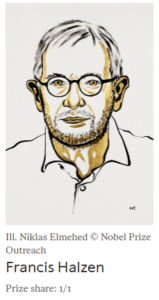
The Royal Swedish Academy of Sciences today announced that the 2026 Nobel Prize in Physics is being awarded to
Francis Halzen
University of Wisconsin-Madison, USA
for his work in laying the foundation for an entirely new type of astronomy which tracks neutrinos that originate in the distant cosmos.
The official citation reads: “for decisive contributions to the IceCube Neutrino Observatory and the discovery of high-energy neutrinos of astrophysical origin“.
Francis Halzen realised that ice at the South Pole could be used to track particles known as neutrinos. His vision and scientific leadership have been fundamental for the IceCube Neutrino Observatory – a cubic kilometre of ice that is equipped with light sensors. Using IceCube, researchers can capture neutrinos from extremely energy-rich processes in the distant universe.
For more information, see the 2026 announcement on the Nobel Prize webpage.
As of April 2025, the IceCube collaboration includes 450 people from 58 institutions in 14 countries (31 U.S. and Canada, 21 Europe and 6 Asia Pacific), including Queen’s University, Simon Fraser University, and the University of Alberta.
The Institute of Particle Physics notes that IceCube Canada currently consists of five faculty members, four at the University of Alberta and one at the University of Toronto. Canadian activities in IceCube focus on the particle physics available at the low end of the IceCube detector’s energy range (< 1 TeV).